Opinion paperMacroeconomy & fiscal policy
Ghana’s 2026 Domestic Debt Financing
An evidence-led assessment of liquidity pressures and unconventional issuance practices
Introduction
Ghana’s recent public debt situation appears to have improved, but the central policy question is whether the debt position and financing system have become durable, transparent, and market based. The recovery has benefited from debt-service relief under the DDEP, external restructuring, IMF programme discipline, expenditure compression, favourable gold prices, and domestic policy measures. These supports have eased immediate pressure, but they do not by themselves remove refinancing risks. The decisive test is whether Government can meet obligations, finance budget deficits, and extend maturities without accumulating arrears, suppressing investor returns, relying on opaque placements, or weakening the domestic yield curve. Since the DDEP, debt has also been managed through a widening set of tools outside regular competitive auctions: reopenings and possible placements of DDEP bonds, non-cash issuance, payment-in-kind coupons, Sinking Fund prefunding, and a planned liability-management programme.
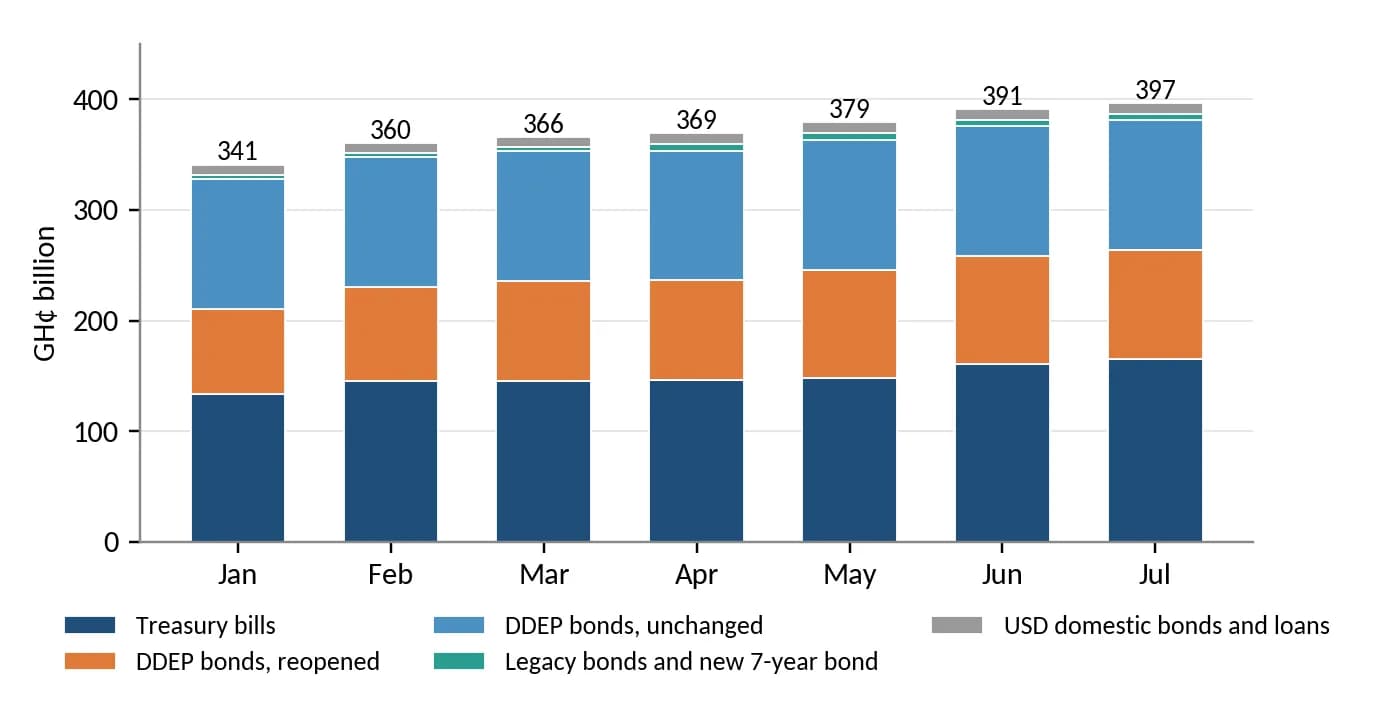
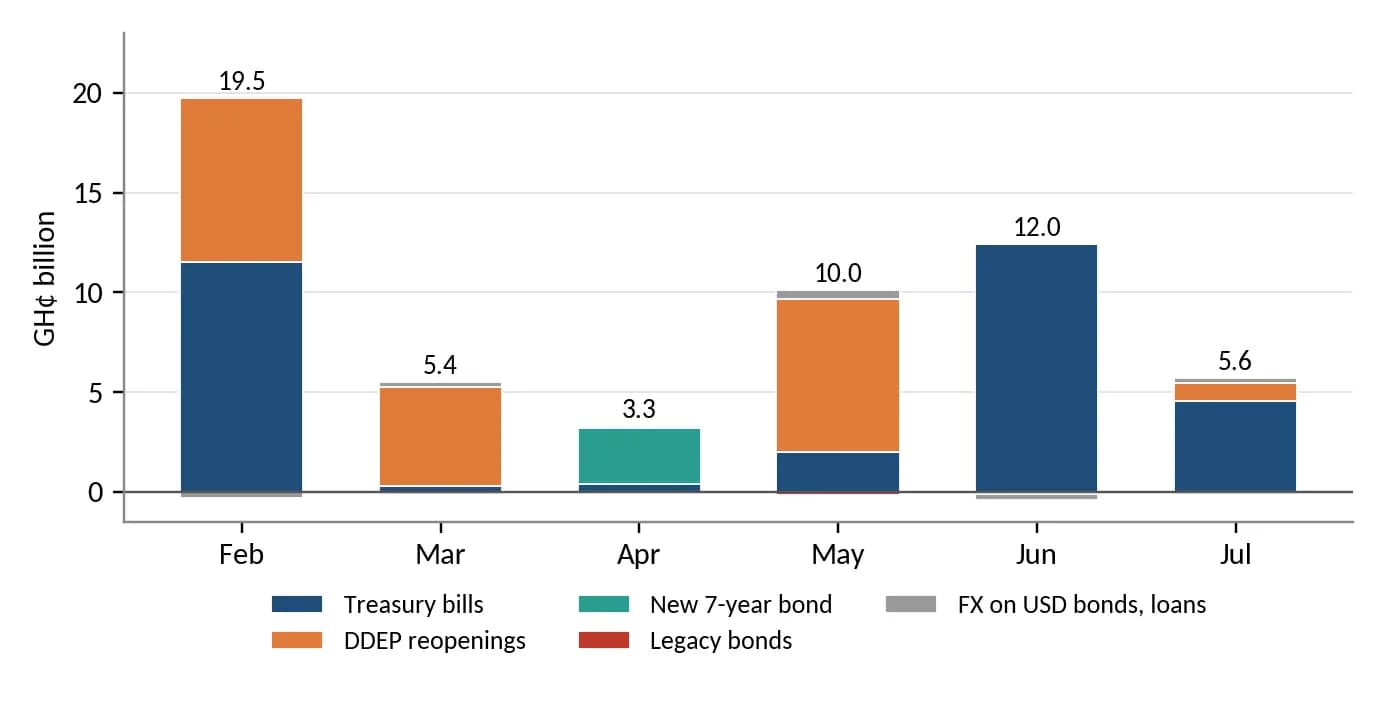
Through unconventional debt issuance methods, we are seeing a material build-up in domestic debt obligations. Between January and July 2026, central-government domestic debt rose from GH¢340.98 billion to GH¢396.69 billion, an increase of GH¢55.71 billion (16.3%), while total central-government debt increased from GH¢663.43 billion to GH¢733.94 billion. Domestic debt rose from 21.3% to 24.8% of revised nominal GDP and accounted for roughly four-fifths of the increase in the central-government debt stock. Domestic debt increase has been decomposed almost completely (Figures 1 and 2): Treasury bills contributed GH¢31.2 billion, reopenings of eight DDEP bonds GH¢21.8 billion, and the new seven-year bond GH¢2.8 billion, while exchange-rate revaluation of the domestic US-dollar bonds added only GH¢0.6 billion, offset by GH¢0.5 billion of redemptions of legacy pre-DDEP bonds and a small fall in standard loans. The movement is therefore overwhelmingly new issuance rather than valuation. What remains to be established is the cash raised, since the stock is recorded at face value and reopened bonds may have been sold below par.
1. Debt stock, composition, and financing signals
| Measure | Observed movement | Debt-management significance |
|---|---|---|
| Central-government domestic debt | GH¢340.98bn to GH¢396.69bn; increase of GH¢55.71bn. | Domestic financing drove about four-fifths of the increase in central-government debt; exchange-rate revaluation explains only GH¢0.6bn of the domestic rise. |
| Total central-government debt | GH¢663.43bn to GH¢733.94bn; increase of GH¢70.51bn. | The external component rose by GH¢14.8bn in cedi terms even though it fell by about US$0.6bn in dollar terms; its cedi increase is entirely valuation. |
| Domestic debt/GDP | 21.3% to 24.8% of revised nominal GDP. | Greater reliance on the domestic market raises rollover, crowding-out, bank-sovereign, and interest-cost risks. |
| Total central-government debt/GDP | 41.5% to 45.9%. | Part of the rise is mechanical because the data holds nominal GDP constant across months; the direction of travel still warrants scrutiny of deficit financing and recognised arrears. |
| Short-term domestic instruments | GH¢133.9bn to GH¢165.0bn (+GH¢31.2bn, +23.3%); share of domestic debt 39.3% to 41.6%. | Bills grew faster than bonds and remain far above the Medium-Term Debt Strategy benchmark of 15±5% of domestic debt, keeping rollover needs high. |
| 364-day bills | GH¢49.3bn to GH¢98.4bn; share of the bill stock 36.8% to 59.6%, while 91-day and 182-day stocks fell by GH¢11.6bn and GH¢6.3bn. | The shift lengthens the bill portfolio and reduces auction frequency, but concentrates a large rollover in mid-2027, the year the first DDEP bonds mature. |
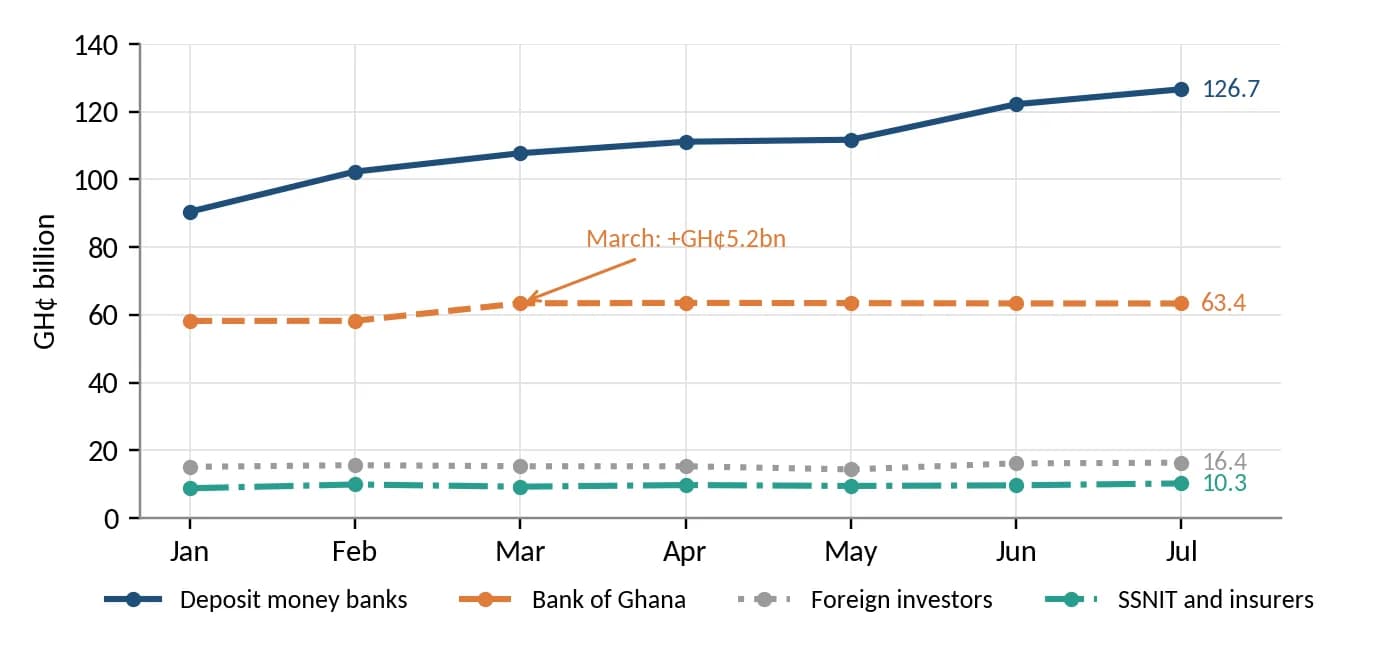
| Banking-system holdings | GH¢148.7bn to GH¢190.1bn (+GH¢41.3bn), of which deposit money banks +GH¢36.2bn; their share of domestic debt rose from 26.5% to 31.9%. | Higher bank exposure can strengthen captive demand but deepen the sovereign-bank nexus and constrain private credit. |
| Bank of Ghana holdings | GH¢58.2bn to GH¢63.4bn (+GH¢5.15bn), of which +GH¢5.17bn in March alone. | The dollar series (US$5.32bn to US$5.42bn) understates the movement because of cedi depreciation. The March rise coincides with GH¢5.0bn of DDEP reopenings; the acquisition route is unconfirmed. |
| DDEP bond reopenings | GH¢77.1bn to GH¢98.9bn across eight bonds (+GH¢21.8bn); four other DDEP bonds unchanged. | Issuance into existing lines; sale method, price, and counterparties are not disclosed. |
| Legacy (pre-DDEP) bonds | GH¢3.39bn to GH¢2.89bn (−GH¢0.50bn), excluding the April seven-year issue. | Steady run-off of non-tendered holdings; the seven-year line is misclassified. |
Figure 1. Central-government domestic debt by instrument, January–July 2026 (GH¢ billion)
 Graphic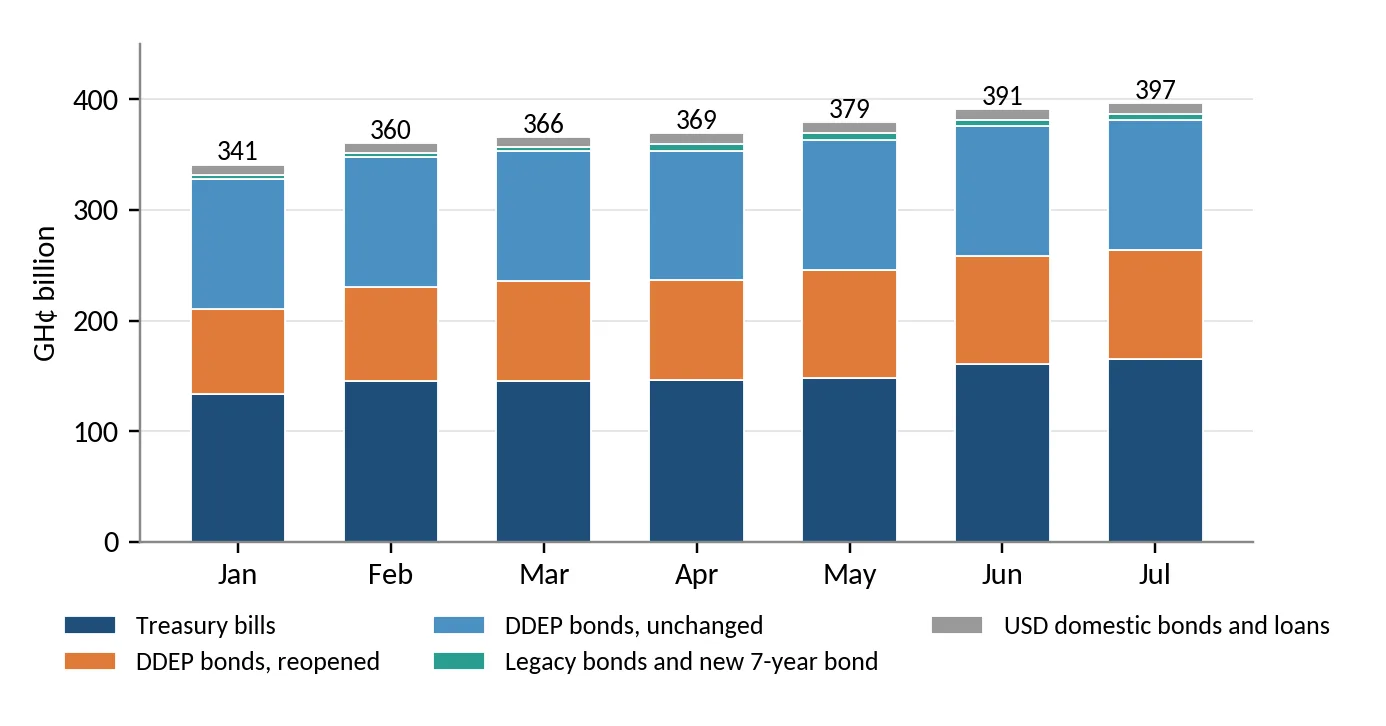
Source: Ministry of Finance debt workbook (provisional), converted to cedis at the exchange rates implied by the workbook’s own cedi totals. The legacy-bond series includes the April seven-year issue, which the workbook books to the legacy line.
Figure 2. Monthly net change in domestic debt by source, February–July 2026 (GH¢ billion)
 Graphic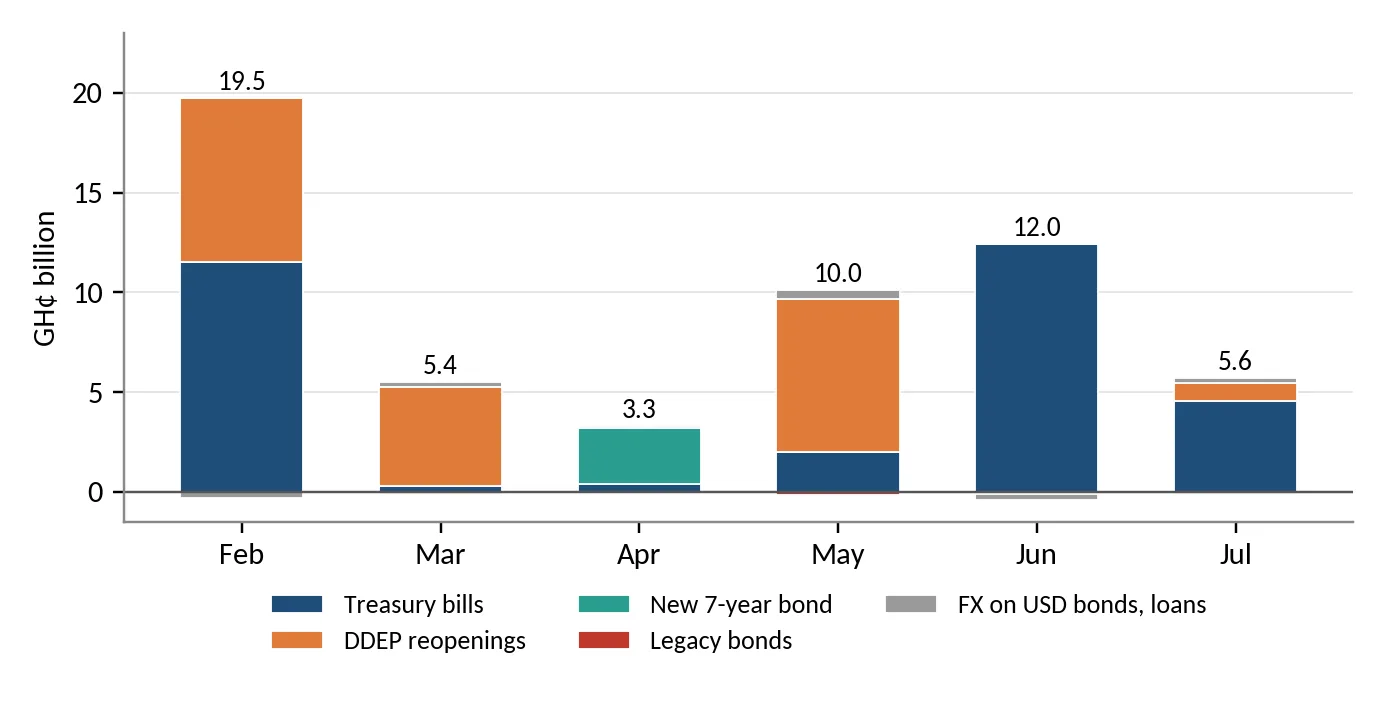
Source: Ministry of Finance debt workbook (provisional), converted to cedis at the exchange rates implied by the workbook’s own cedi totals. Labels show the monthly total.
The macroeconomic backdrop matters chiefly through its effect on debt dynamics. Lower inflation and exchange-rate stability can reduce nominal yields and the cedi value of external liabilities, while stronger growth enlarges the denominator used in debt ratios. These gains are helpful but reversible: the provisional debt database implied exchange rate weakened by about 6% between January and July 2026, after the cedi’s 40.7% appreciation in 2025. They do not answer whether the primary balance is durable, whether arrears are being recognised, whether domestic maturities are lengthening, or whether new debt is being priced competitively.
2. What restructuring changed—and what it did not
Cash-flow relief is not debt extinction. The DDEP, Eurobond restructuring, and official-creditor treatment reduced near-term cash debt service, extended maturities, and shifted part of the adjustment cost to creditors. That relief was indispensable: it lowered immediate rollover pressure and created room for fiscal operations. But most restructured principal remains a Government obligation. Maturity extensions postpone rather than eliminate refinancing needs, while step-up coupons and future amortisation cliffs can cause debt service to rise again after the relief period. The cliff is now close: in the 2026 Mid-Year Review the Finance Minister put DDEP repayments at GH¢58 billion in 2027 and GH¢53 billion in 2028, against a Sinking Fund balance of GH¢15.6 billion on 22 July 2026 and a year-end projection of GH¢30 billion.
The post-DDEP stock requires a full bridge. A credible debt account should reconcile, security by security, the opening face value, exchanges, reopenings, new issuance, redemptions, interest capitalisation, valuation effects, and closing face value. The MoF’s provisional database supports a partial bridge at line level. Once converted to cedis, eight DDEP bond lines show round-number increases totalling GH¢21.8 billion, and three lines (the 2030, 2032 and 2038 bonds) match the Ministry’s end-2025 balances exactly, confirming which data line corresponds to which bond. Capitalised interest can be excluded for the period, because the February 2026 coupon was paid fully in cash. The bridge cannot be completed without transaction dates, prices, and cash proceeds, and the database’s January balances for the same bonds already exceed the Ministry’s end-2025 figures by GH¢7.4 billion, a gap that should be reconciled.
Debt sustainability remains sensitive to policy and market shocks. A stronger cedi reduces the reported cedi value of external debt, and high gold prices support reserves and confidence. The cedi’s 2025 appreciation reduced the cedi value of external debt by GH¢125.3 billion without any change in contractual foreign-currency principal. The reverse is already visible in 2026: between January and July, external debt fell by about US$0.6 billion in dollar terms yet rose by GH¢14.8 billion in cedi terms. A larger reversal in the exchange rate, weaker commodity prices, or slower growth could quickly raise the debt ratio and debt-service burden. Sustainable improvement therefore depends on primary surpluses, revenue reliability, disciplined commitment control, and financing at maturities and yields the state can service without repeated restructuring.
The domestic market now carries more of the adjustment. With new external commercial borrowing limited, Government depends more heavily on domestic investors and the banking system. This can provide a stable funding base, but it also concentrates sovereign risk in banks, pensions, insurers, and households already affected by the DDEP. Deposit money banks absorbed roughly two-thirds of the net domestic borrowing between January and July 2026. If yields at the short end are held below what voluntary investors would demand, the cash interest bill falls in the short run, but confidence, secondary-market liquidity, and willingness to commit to longer maturities may weaken.
3. Financial repression, bill concentration, and the sovereign-bank nexus
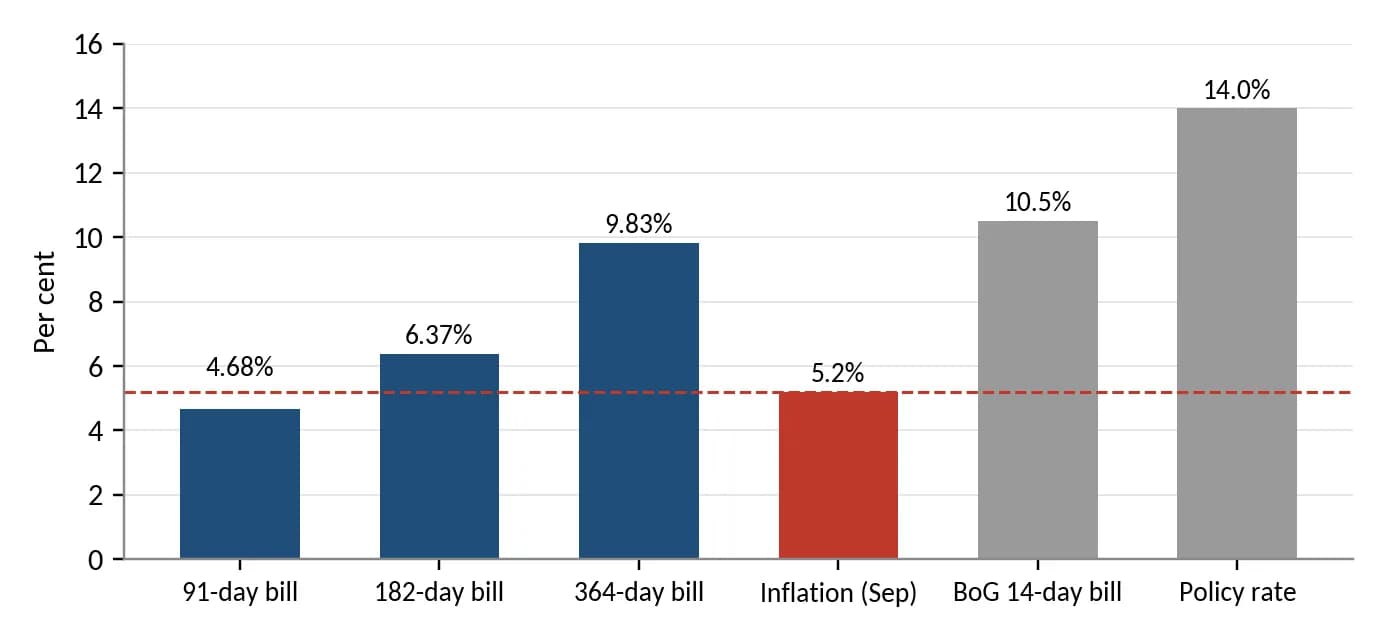
At the 12 October 2026 auction, the 91-day Treasury bill yielded 4.60%, below September inflation of 5.2%, while the policy rate stood at 14.0% and the 14-day BoG bill yielded 10.50%. The negative real return is, however, confined to the very short end. The 364-day bill yielded about 9.8% at the end of September, a real return of roughly 4.6 percentage points (Figure 3), and one-year paper now makes up almost three-fifths of the bill stock. The evidence of financial repression is therefore narrower than the 91-day rate alone suggests. A 91-day rate nearly ten points below the policy rate does indicate that very short Treasury paper is priced by captive liquidity demand rather than by the monetary stance. If investors accept low yields because regulation, liquidity rules, limited alternatives, or institutional pressure make sovereign paper effectively captive, the market price ceases to be a reliable measure of Ghana’s credit and duration risk, and the resulting curve can understate the true cost at which voluntary investors would fund Government.
Figure 3. Treasury bill yields against inflation and policy rates, late September 2026 (per cent)
 Graphic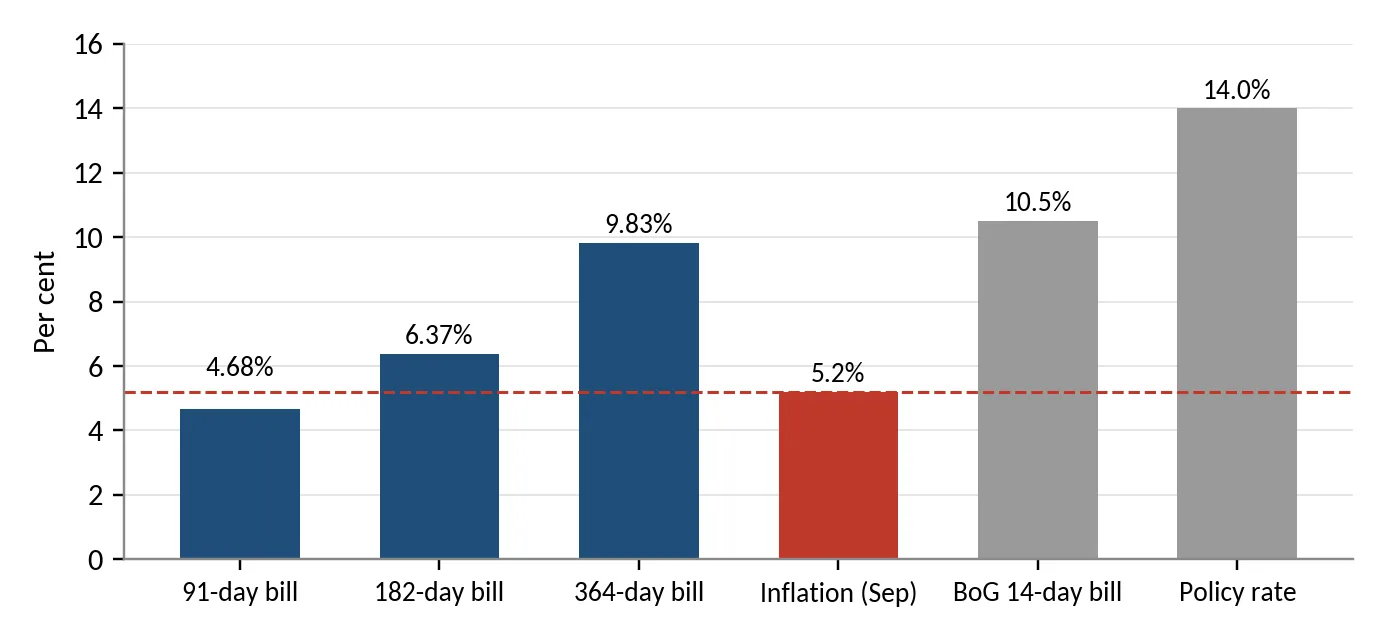
Sources: Bank of Ghana auction of 28 September 2026 (interest-equivalent yields); Ghana Statistical Service (September inflation); Bank of Ghana. The 91-day yield fell further, to 4.60%, at the 12 October auction.
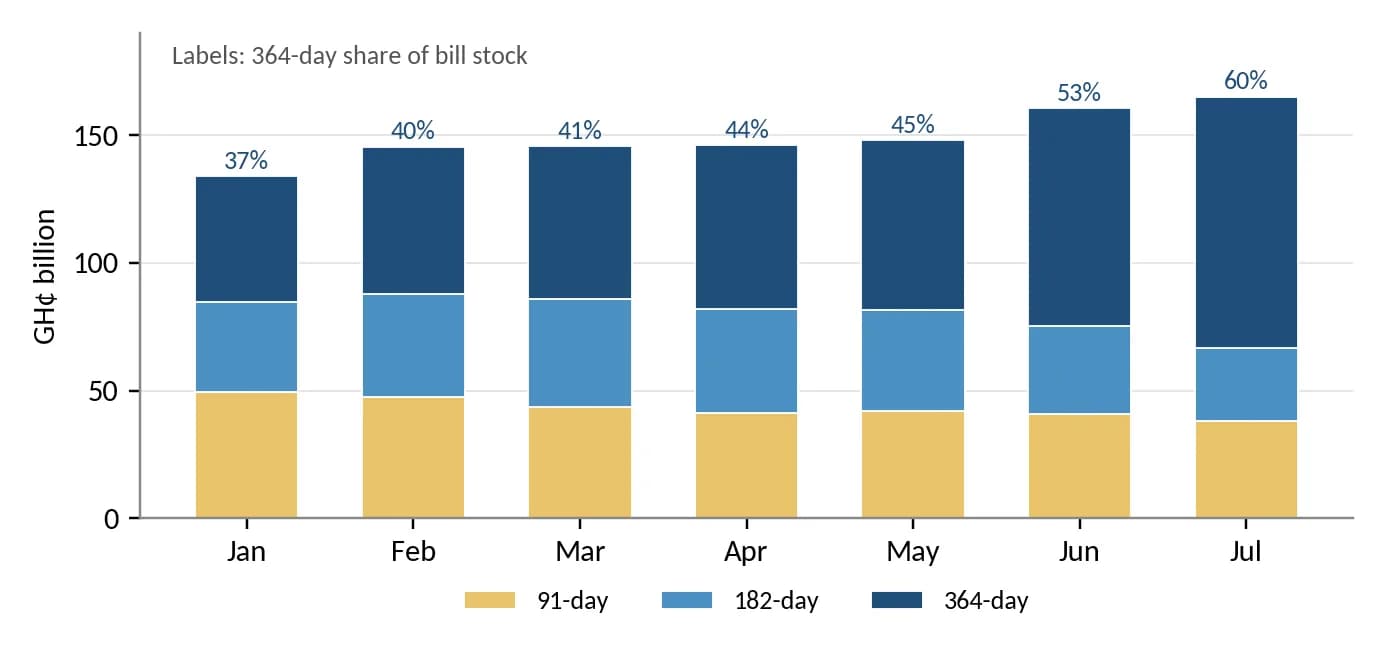
The Data does not show maturity shortening within the bill portfolio; it shows the opposite (Figure 4). In cedi terms, the 364-day stock doubled from GH¢49.3 billion to GH¢98.4 billion, while the 91-day and 182-day stocks fell by GH¢11.6 billion and GH¢6.3 billion. The risk lies in the overall mix. Bills grew faster than bonds, rising from 39.3% to 41.6% of domestic debt against a strategy benchmark of 15±5%, and the GH¢31.9 billion of net one-year issuance in June and July will fall due in mid-2027, the same year as the first DDEP redemption. A Government that must refinance a large stock every few months is vulnerable to auction undersubscription, sudden yield repricing, and liquidity shocks. Meanwhile, banking-system holdings rose by GH¢41.3 billion, of which GH¢36.2 billion was held by deposit money banks, lifting their share of domestic debt from 26.5% to 31.9% (Figure 5). This deepens the sovereign-bank nexus: banks gain liquid collateral and interest income, but their balance sheets become more sensitive to sovereign valuation, restructuring, and payment risk, potentially displacing private-sector lending.
Figure 4. Treasury bill stock by tenor, January–July 2026 (GH¢ billion)
 Graphic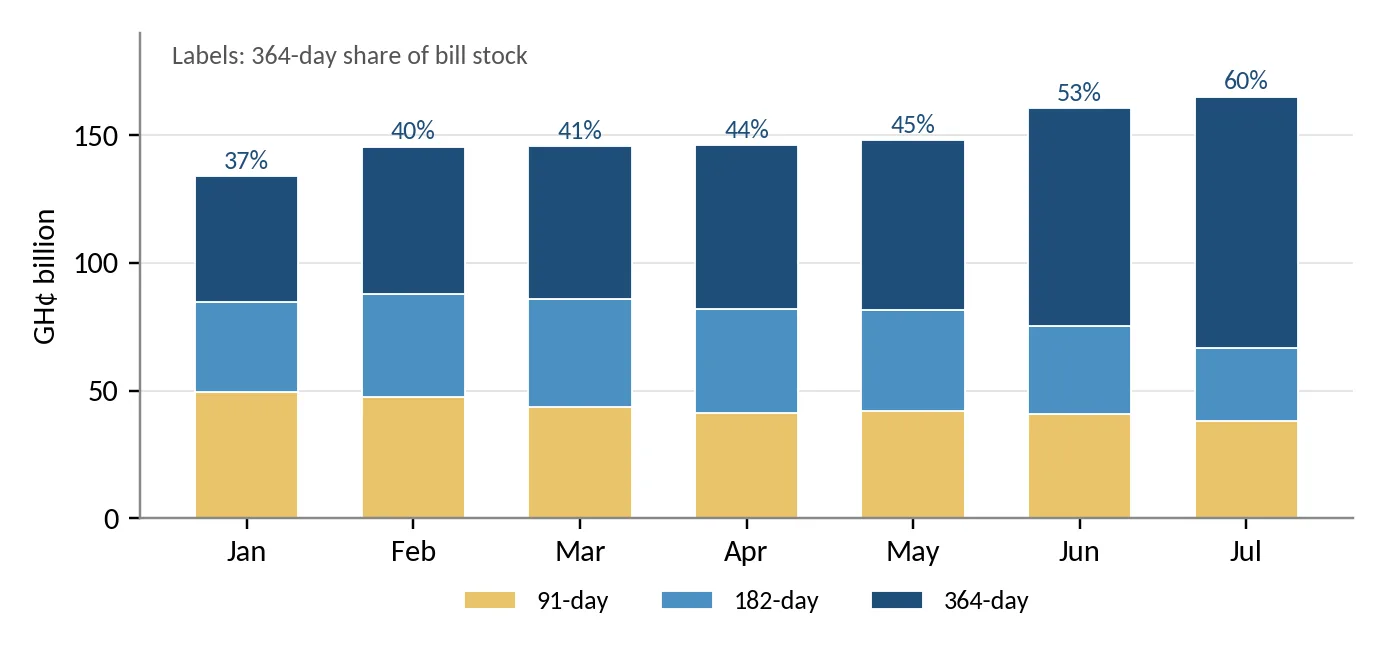
Source: Ministry of Finance debt workbook (provisional), converted to cedis at the exchange rates implied by the workbook’s own cedi totals.
Figure 5. Holders of central-government domestic debt, January–July 2026 (GH¢ billion)
 Graphic
Source: Ministry of Finance debt workbook (provisional), converted to cedis at the exchange rates implied by the workbook’s own cedi totals.
4. Unconventional debt-management tools
Since the DDEP, Government has met its financing needs and managed its maturity profile with a widening set of tools that sit outside regular, competitive bond auctions. Some were forced by the restructuring; others are being adopted as the market reopens. The issue is whether each tool is visible, priced against the market, and accounted for. This section assesses the toolkit against four tests: visibility (whether the transaction appears in the issuance calendar and published results), pricing (whether its cost can be checked against the market curve), cash content (whether it raises money or only creates a claim), and incidence (whether the cost falls on taxpayers, investors, banks, or the central bank).
| Tool | Evidence | Assessment |
|---|---|---|
| Reopenings and taps of DDEP bonds | GH¢21.8bn of face value added to eight bonds, February–July 2026. | Visible only in stock data; price, cash proceeds, and counterparties undisclosed. |
| Direct or private placements | Bank of Ghana holdings rose GH¢5.17bn in March, as GH¢5.0bn was reopened. | Lowest visibility; pricing cannot be tested; possible central-bank financing. |
| Non-cash issuance | GH¢2,076m of securities used to recapitalise NIB, ADB, and CBG in 2025. | Raises no cash; future coupons fall on the budget; usually outside the auction calendar. |
| Payment-in-kind coupons | GH¢3,747m of 2025 DDEP coupons capitalised; 2026 coupons paid in cash. | Rule-based and visible, but adds principal without borrowing; now discontinued. |
| Sinking Fund prefunding | 7% of non-oil tax revenue plus bond proceeds; GH¢15.6bn on 22 July 2026. | Visible in aggregate only; borrowing to hold cash carries a cost if the fund earns less than the debt. |
| Liability management and reprofiling | Programme announced for 2026 to smooth the 2027–28 maturities. | Not yet visible; the main test of whether the cliff is handled through the market. |
| Tax-exempt, revenue-backed infrastructure bonds | GH¢10bn planned in two GH¢5bn tranches of 10- and 15-year bonds. | Coupon understates cost because of forgone tax; ring-fenced revenue reduces budget flexibility. |
| Central-bank bills alongside Treasury bills | 14-day BoG bill at 10.50% against the 91-day Treasury bill at 4.60%. | Visible, but segmentation blurs the price signal; sterilisation cost sits with the BoG. |
| Arrears and withheld statutory transfers | Not reported. | Least visible; financing by delaying payment obligations. |
| Non-guaranteed public-corporation debt | About GH¢9.7bn, mostly COCOBOD domestic debt (GH¢7.17bn). | Domestic lines unchanged to the cedi for seven months; stale data and a contingent liability. |
Tools that create debt without a competitive auction. Reopenings, direct placements, non-cash issuance, and payment-in-kind coupons all increase the stock of bonds without passing through a public, competitive sale. Reopenings are the least problematic when they are announced and auctioned, because they build liquid benchmark lines. Placements and non-cash issues are the most problematic, because neither the price nor the counterparty is observable. The 2025 recapitalisation of three state-interest banks with GH¢2,076 million of Treasury securities shows that non-cash issuance is an established part of the toolkit. It is therefore a live explanation for at least part of the 2026 reopenings, alongside market taps and placements with the Bank of Ghana. Payment-in-kind coupons added GH¢3,747 million to principal in 2025; they have now ended, but they illustrate how the stock can grow without any new financing decision.
Tools that manage the 2027–28 cliff. The Sinking Fund and the announced liability-management programme are the tools that will decide whether GH¢111 billion of DDEP principal is repaid, refinanced, or reprofiled. Prefunding is prudent, but it means part of the 2026 increase in debt may be cash held for future redemptions rather than deficit financing. That borrowing carries a cost whenever the fund earns less than the debt raised to fill it, so the fund’s balance, investments, and yield should be reported monthly. Liability-management operations, such as switching 2027 and 2028 bonds into longer maturities or buying them back, can smooth the cliff. They are also the operations most exposed to the concerns raised in this assessment: if switches are offered on non-market terms or to selected holders, they would amount to a second restructuring by administrative means.
Tools that move cost off the coupon line. Tax-exempt, revenue-backed infrastructure bonds pay a lower coupon because investors are spared tax, so the true cost to Government is the coupon plus the tax forgone. Ring-fencing project revenues to service them also narrows the budget’s room for manoeuvre. Arrears, withheld statutory transfers, and debt held by public corporations shift financing to suppliers, funds, and state enterprises rather than eliminating it. The workbook’s non-guaranteed public-corporation lines illustrate the reporting gap: COCOBOD’s domestic debt of GH¢7.17 billion is identical to the cedi in every month from January to July, which suggests the figures are carried forward rather than updated, and the block sits under a US-dollar heading although its values behave as cedis.
Tools that shape the price of government debt. Negative real yields on 91-day bills, high bank holdings, and Bank of Ghana bills paying far more than Treasury bills of similar tenor all affect what Government pays to borrow. The central bank’s sterilisation instruments, including 14-day and 273-day bills introduced in 2025, compete with Treasury paper for the same liquidity. The resulting segmentation can lower the fiscal interest bill while shifting cost to the central bank’s balance sheet and blurring the yield curve that new bonds are meant to rebuild.
From crisis tools to transition tools. Taken together, the evidence shows Ghana moving from crisis tools (the DDEP exchange and payment-in-kind coupons) to transition tools (reopenings, possible placements, non-cash issues, and prefunding). This is a normal path out of restructuring, but transition tools are meant to be temporary. The test for 2027 is whether they give way to regular, calendar-based, competitive issuance, or become a permanent route around it.
5. Case study: DDEP-bond reopenings, possible placements, and the April auction
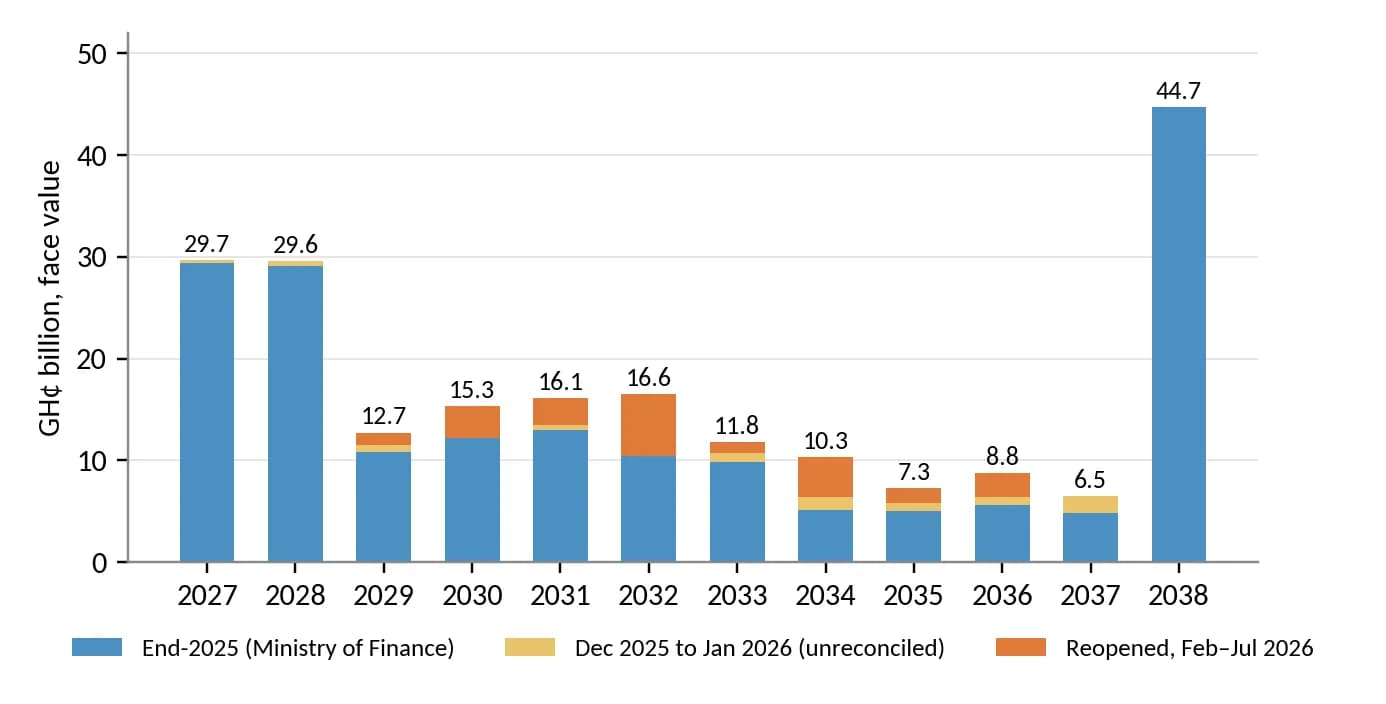
The GH¢21.8 billion increase in the face value of DDEP bonds can be reproduced from the data. Once each line is converted to cedis, eight of the twelve DDEP General Category bonds, those maturing between 2029 and 2036, rise in round-number increments in four episodes: GH¢8.26 billion in February, GH¢5.0 billion in March, GH¢7.65 billion in May, and GH¢0.92 billion in July (Table 3 and Figure 6). The remaining four bonds, maturing in 2027, 2028, 2037 and 2038, do not change. This pattern rules out exchange-rate effects, and it rules out capitalised interest, which would raise all twelve bonds in proportion. The increases are therefore issuance into existing lines through reopenings or taps, at a scale roughly five times the 2025 pace. What the workbook cannot show is how the bonds were sold. A public tap, a private placement, and a non-cash issue such as a recapitalisation or arrears settlement would leave an identical trace in the stock data.
| Bond (maturity, coupon) | Additions by month | Stock, January → July |
|---|---|---|
| Feb 2029 (8.65%) | May: 1,179.6 | 11,568.5 → 12,748.1 (+10%) |
| Feb 2030 (8.80%) | Feb: 1,273.4; May: 1,862.8 | 12,203.0 → 15,339.2 (+26%) |
| Feb 2031 (8.95%) | May: 2,593.2 | 13,523.5 → 16,116.7 (+19%) |
| Feb 2032 (9.10%) | Feb: 4,111.5; May: 2,015.3 | 10,426.2 → 16,553.0 (+59%) |
| Feb 2033 (9.25%) | Mar: 1,000.0 | 10,769.5 → 11,769.5 (+9%) |
| Feb 2034 (9.40%) | Feb: 2,873.9; Mar: 1,000.0 | 6,457.7 → 10,331.5 (+60%) |
| Feb 2035 (9.55%) | Mar: 1,500.0 | 5,779.6 → 7,279.6 (+26%) |
| Feb 2036 (9.70%) | Mar: 1,500.0; Jul: 917.5 | 6,365.0 → 8,782.4 (+38%) |
| Total | 21,827.1 | 77,093.0 → 98,920.1 (+28%) |
Figure 6. DDEP General Category bonds by maturity year, end-2025 to July 2026 (GH¢ billion, face value)
 Graphic
Sources: Ministry of Finance, 2025 Annual Public Debt Report (end-2025 balances); Ministry of Finance debt workbook (2026, cedi-converted). The January 2026 balances exceed the end-2025 figures by GH¢7.4 billion; this gap is unreconciled.
The GH¢5.2 billion Bank of Ghana component is best treated as a strong but circumstantial inference. In cedi terms, Bank of Ghana holdings rose by GH¢5.17 billion in March, the month in which GH¢5.0 billion was added to four DDEP bonds, and then stayed broadly flat; the bill stock barely moved that month. The US-dollar holder series shows only a modest rise because cedi depreciation compresses it, so it cannot be used to dismiss the movement. The coincidence does not, however, establish the acquisition route, legal basis, settlement value, or whether the transaction amounted to central-bank financing. Given the commitment to zero central-bank financing in 2026, it should be confirmed through Central Securities Depository records and the Bank’s reported claims on government before it is asserted.
Two data issues also affect interpretation. First, the April seven-year bond appears to have been booked to the legacy ‘7-year GoG bond (old)’ line, which rises by GH¢2.78 billion in April; it should be reported as a new instrument, otherwise legacy bonds appear to grow when they are in fact running off. Second, the stock is recorded at face value. The reopened bonds carry coupons of 8.65–9.70%, while comparable DDEP bonds traded at yields near 13% and prices of about 83–84 in April, so cash proceeds may have been materially below the GH¢21.8 billion added to the stock. The reopenings also add about GH¢2.0 billion a year in coupon payments.
The April seven-year transaction provides a useful benchmark. Government received GH¢3.1 billion of bids and accepted GH¢2.7 billion at a 12.5% coupon, with maturity on 29 March 2033; the data records GH¢2.78 billion. Its book-building process and intended listing gave it more visibility than a bilateral placement, and its coupon sat slightly below the roughly 13% secondary-market yields on adjacent DDEP maturities at settlement. The coupon is still not the full cost. Proper evaluation requires the issue price, yield to maturity, accrued interest, underwriting and placement fees, investor allocation, and settlement terms. A bond sold below par or carrying substantial fees may be more expensive than its coupon suggests.
Reopenings and taps can be sound debt-management tools when they enlarge benchmark lines, improve secondary-market liquidity, and reduce fragmentation. The concern is process. A transparent reopening should disclose the instrument, amount, price, yield, accrued interest, allocation method, cash proceeds, and effect on the maturity profile. A private placement should additionally explain why competitive issuance was unsuitable and demonstrate value for money against a contemporaneous market curve. Without these disclosures, pricing cannot be independently tested, preferred counterparties may receive hidden advantages, and off-calendar borrowing can obscure the Government’s true financing need. The governance risk is therefore not that every private placement is corrupt, but that opacity removes the controls needed to establish that it is not.
6. Conclusions and recommendations
The debt evidence supports a sharper conclusion than the macroeconomic headlines alone. Ghana has obtained valuable breathing space, but its debt problem has changed form rather than disappeared. External restructuring and the DDEP reduced near-term cash service, while domestic debt, Treasury bills, and banking-system exposure increased, and GH¢111 billion of DDEP principal falls due in 2027 and 2028. Debt management has meanwhile shifted from crisis tools to transition tools: GH¢21.8 billion of DDEP reopenings between February and July 2026, at least one episode that may have been a direct placement, non-cash issuance, and Sinking Fund prefunding, with a liability-management programme still to come. Each private placement reduces visibility or moves cost away from the coupon line, and their persistent use without security-level disclosure would be inconsistent with a credible programme to rebuild the domestic debt market. The strongest evidence of recovery will be a transparent debt bridge, longer average maturity, reliable statutory payments, declining arrears, competitive pricing, a disclosed and market-based approach to the 2027–28 maturities, and reduced dependence on captive domestic financing.
- Publish a security-level monthly debt register showing ISIN, opening face value, new issuance, taps, exchanges, redemptions, accrued interest, holder class, and closing balance.
- Disclose every non-competitive transaction within five business days, including legal basis, counterparty category, price/yield, fees, allocation rationale, and comparison with the prevailing secondary curve.
- Reconcile fiscal financing and debt statistics so that changes in debt stock are decomposed into cash borrowing, valuation effects, arrears recognition, and reclassification.
- Publish monthly budget execution and arrears data, including statutory transfers due, paid, and outstanding by fund.
- Use competitive auctions as the default; permit private placements only under a documented exception framework with independent value-for-money review.
- Coordinate MoF and BoG issuance to reduce unnecessary rate segmentation and explain differences between fiscal bills, OMO bills, and the policy rate.
- Rebuild the yield curve deliberately through predictable calendars, benchmark reopenings, primary-dealer obligations, and transparent auction results.
- Strengthen oversight through quarterly reporting to Parliament, Auditor-General access to placement documentation, and publication of beneficial-intermediary and fee information where legally permissible.
- Correct and publish the debt workbook in cedis, reclassify the April seven-year bond as a new instrument, and reconcile the January 2026 DDEP balances with the end-2025 figures.
- Publish a liability-management framework before any switch or buyback of the 2027 and 2028 bonds, setting out eligibility, pricing against the secondary curve, and equal access for all holders.
- Report the Sinking Fund monthly, including inflows by source, the share funded by borrowing, investments, yield, and planned drawdowns.
- Disclose the full cost of infrastructure bonds, including tax revenue forgone through exemptions and the revenues ring-fenced to service them.
- Update public-corporation debt monthly, correct the currency labelling of the non-guaranteed block, and publish COCOBOD’s debt by instrument.
The Africanomics Brief